


There is a moment that almost every foreigner working in Japan experiences within their first few weeks on the job. An email goes out, or a senior colleague quietly passes the word around the office, and suddenly everyone is gathering their things at the end of the day with an air of mild anticipation. There is a party tonight. And whether you drink or not, whether you are an introvert or the life of every gathering back home, this particular kind of party matters in ways that go beyond the evening itself.
Japan’s workplace drinking culture is one of those aspects of life here that surprises newcomers — not because it is extreme, but because it is so deliberate. It serves a genuine social function, it has its own vocabulary, and navigating it well can do more for your professional relationships in a single evening than weeks of polite hallway exchanges. Understanding what is happening around you — linguistically, culturally, and socially — turns what might otherwise feel like an obligation into something genuinely interesting.
The Izakaya: Japan’s Living Room After Hours

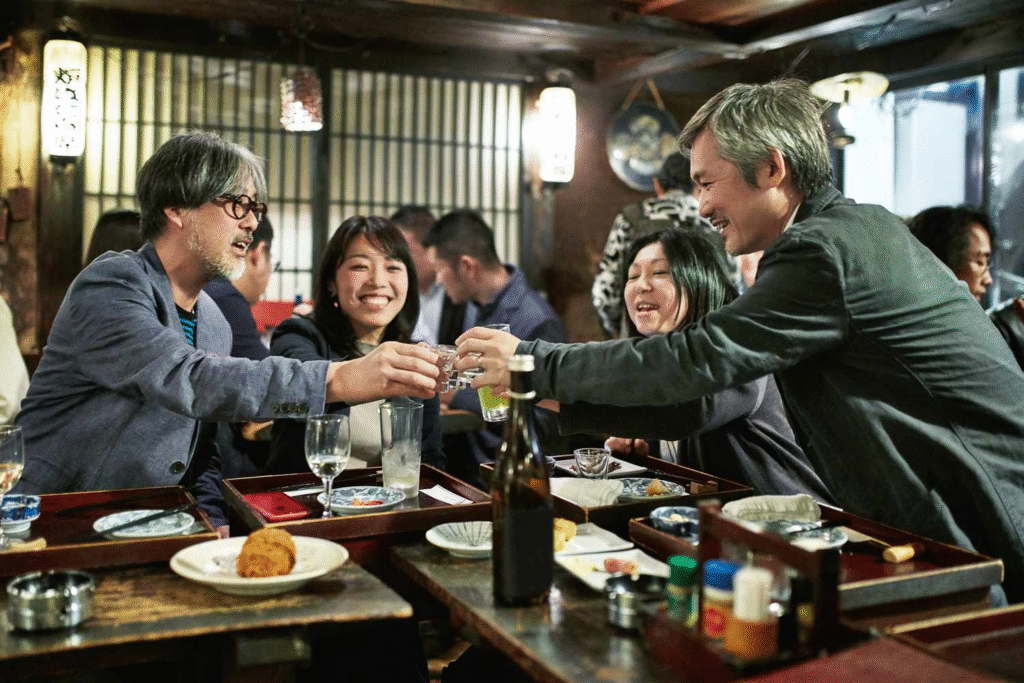
Most of these gatherings happen in an 居酒屋 (izakaya) — the Japanese pub that functions as the unofficial communal space of the working world here. Step inside any izakaya on a weekday evening and you will find a familiar scene: groups of colleagues crowded around low tables, small plates of food arriving in a steady stream, glasses being refilled with practiced ease.
The izakaya is worth understanding on its own terms. It is not quite a bar and not quite a restaurant. It exists in a comfortable middle ground where the food is meant to be shared, the drinks arrive continuously, and the expectation is that you will settle in rather than cycle through. For many Japanese workers, it represents a rare space of genuine informality — a place where the strict hierarchical rules that govern office communication can, if only for an evening, soften a little.
The seating itself follows a logic that is worth knowing. The most senior people at the gathering will typically sit at the far end of the table, away from the entrance — a position called 上座 (kamiza), or the seat of honor. Junior members sit closer to the door, in the 下座 (shimoza). If you are new to the team, you may find yourself near the door without anyone explaining why. Now you know.
Kanpai: The Toast That Starts Everything
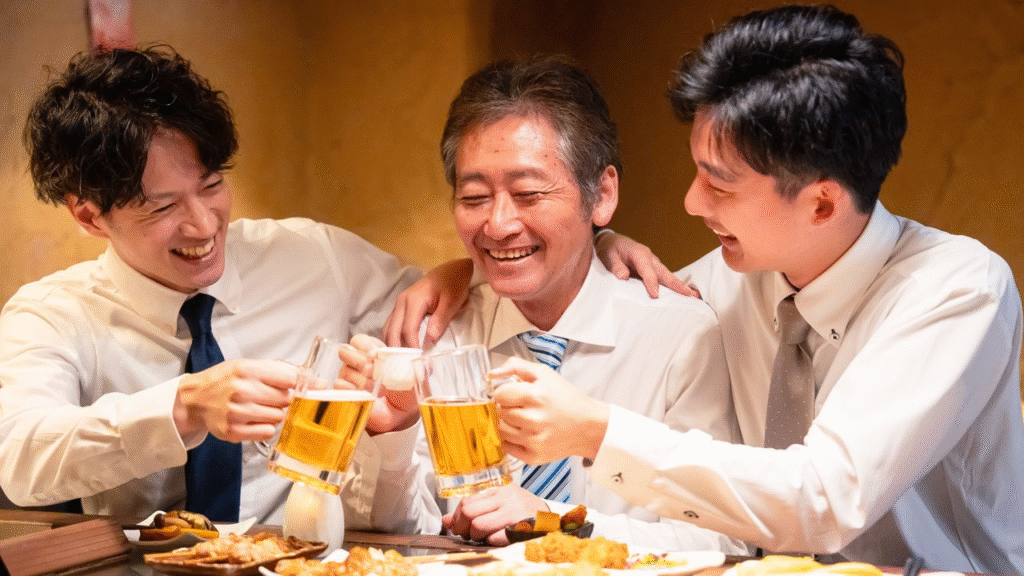
The moment the drinks arrive, someone — usually a senior colleague — will raise their glass and call out 乾杯 (kanpai). Everyone raises their glass in response, there is a brief moment of collective energy, and then the evening properly begins.
乾杯 is one of those words that rewards a second look. It is made up of two kanji: 乾 (kan), which means dry, and 杯 (pai or hai), which is the counter used for glasses or cups of liquid. Put them together and you get something that translates roughly as “dry the glass” — a rather vivid instruction to drink up. There is something charming about the fact that Japan’s universal toast is essentially a cheerful command to empty whatever is in front of you.
That second character, 杯, turns out to be genuinely useful beyond the toast itself. It is the counter you use when ordering drinks, and knowing it will serve you well at any izakaya table. 一杯 (ippai) is one glass. 二杯 (nihai) is two. Put it into a sentence and you get something like ワイン一杯飲もう — “let’s have a glass of wine” — which is both natural and extremely practical. If you are going to learn one counter in Japanese before your first workplace party, make it this one.
The Language of Getting Merry: A Vocabulary Worth Having
One of the pleasures of learning Japanese is discovering how richly the language handles concepts that other languages gloss over with a single word. Drunkenness, it turns out, is one of those concepts.
The base word is 酔う (you), meaning to get drunk or to become intoxicated. It is a useful verb on its own, but where things get interesting is in the compounds it generates. 酔っ払う (yopparai) describes someone who is well and truly drunk — it has a slightly comic quality to it in everyday speech, the way you might describe a friend who has clearly had one too many. 二日酔い (futsukayoi) is the word for a hangover, literally “two-day drunk,” which captures rather precisely the feeling of the morning after catching up with you.
If the evening goes further still, you may encounter 千鳥足 (chidoriashi) — one of the more delightful compound words in the language. It translates literally as “one thousand bird legs,” and it refers to the unsteady, weaving walk of someone who has had significantly more than enough to drink. The image it conjures — some hapless bird tottering on its gangly legs, drink in hand — is hard to shake once you have heard it. Japanese has a gift for this kind of vivid, almost cinematic vocabulary.
Beyond 千鳥足, for the truly committed, there is 泥酔 (deisui) — a word that means absolutely, comprehensively wrecked. This one has a slightly more serious edge to it. You may notice it used as a caption on social media posts featuring people in various states of spectacular inebriation. It is not a word you want associated with your own name at a work event.
What to Say When You Are Having a Great Time (Even If You Are Not)
Here is something worth understanding about Japanese drinking parties that surprises many foreigners: the expectation is not simply that you attend. The expectation is that you appear to be enjoying yourself.
Japanese culture places considerable value on group harmony, and a party where one participant is visibly disengaged or unhappy creates a kind of social friction that people work hard to avoid. This does not mean you need to perform joy you do not feel — but it does mean that expressions of enthusiasm, even when they are somewhat conventional, are both expected and appreciated.
The vocabulary of a good time is worth having ready. 楽しい (tanoshii) means fun or enjoyable, and it is the natural response when someone asks how you are finding the evening. 面白い (omoshiroi) covers interesting or entertaining — it has a slightly broader range than 楽しい and can apply to a conversation, a game, a story, or the party as a whole. If things are really going well, にぎやか (nigiyaka) captures a scene that is lively and full of energy, while 盛り上がる (moriagaru) conveys the sense of a gathering that has hit its stride — thrilling, electric, genuinely alive.
You may notice these words being used even when the party is, frankly, a bit flat. That is not dishonesty so much as social lubrication. The party serves a function beyond entertainment, and keeping the emotional temperature positive helps everyone get what they are actually there for.
When the Party Is Genuinely Terrible
That said, there are parties that are just bad. The food is forgettable, the conversation never quite finds its footing, and you spend the evening watching the clock in your peripheral vision. Japanese has vocabulary for this too, though knowing when and with whom to deploy it is its own skill.
くだらない (kudaranai) describes something dull, worthless, or not worth the trouble — low-key dissatisfaction, expressed carefully. ださい (dasai) is closer to lame or uncool, and has a slightly more casual, younger feel to it. Then there are the more emphatic options: うんざり (unzari) conveys being thoroughly fed up, and むかつく (mukatsuku) is the kind of expression that signals genuine irritation or disgust.
A word of caution on those last two. They are strong, and using them in the wrong company — or at the wrong volume — can damage professional relationships in ways that outlast the party by quite a long time. Japan’s professional culture has a long memory for social missteps, and the izakaya, informal as it feels, is still a work event in most people’s minds. Save the unfiltered commentary for the friends you actually trust.
Nomikai: The Deeper Purpose of the Party
All of this — the vocabulary, the seating, the toasts, the careful management of social energy — serves something specific. The workplace drinking party in Japan is not simply a party. It is a structured form of communication that exists precisely because the formality of the office makes certain kinds of honest interaction difficult.
There is even a word for what happens when it works: 飲みニケーション (nominikēshon). It is a portmanteau of 飲む (nomu, to drink) and コミュニケーション (komyunikēshon, communication). The concept is that the act of drinking together loosens the constraints that hierarchy and formality impose on everyday workplace interaction. Things get said over drinks that would never be said across a conference table. Relationships that took months to inch forward in the office can move significantly in a single evening at an izakaya.
For foreigners navigating Japanese workplace culture, this matters practically. The colleague who seemed reserved or distant in the office may be remarkably warm over an 一杯. The manager who has been difficult to read may become far more human after the third round. This is not a trick or a performance — it is a genuine feature of how Japanese professional relationships develop, and participating in it, even imperfectly, signals that you are making a real effort to engage with the culture rather than observe it from a careful distance.
Many beginners worry that they need to drink heavily to fit in at these events. That is not quite right. What matters more is showing up, participating in the 乾杯, and engaging genuinely with the people around you. If you do not drink, a polite explanation is generally accepted without drama. What people remember is not how much you drank — it is whether you were present, warm, and willing to be part of the group.
The Second Party and the Long Walk to Karaoke
One more thing worth knowing: in Japan, the party often does not end when the izakaya bill arrives. There is a concept called 二次会 (nijikai) — the second party — where a subset of the group migrates to a bar, a karaoke room, or some other venue to continue the evening. And then sometimes a 三次会 (sanjikai) after that.
The karaoke room, in particular, is its own fascinating social space. Japanese karaoke is nothing like the stage-and-microphone version common in other countries. It takes place in private rooms, booked by the group, where everyone can sing (or choose not to) without a stranger audience. The social pressure is lower, the atmosphere is looser, and it is one of the best settings in Japan for the kind of genuine, relaxed connection that 飲みニケーション is designed to produce.
If a colleague you have found hard to reach grabs the microphone at karaoke and belts out an earnest rendition of something you did not expect, take note. You are seeing a side of them that does not often surface in the office. That is the point. And being there for it — present, good-humored, willing to take your own turn at the microphone — is one of the most effective things you can do to build a real professional relationship in Japan.
Planning a Smooth Start in Japan?
Understanding the cultural landscape is one thing. Building the professional life that puts you in that izakaya booth in the first place is another — and that part takes the right support.
ComfysCareer.com helps foreigners find real job opportunities in Japan. To begin your journey, visit https://comfyscareer.com/ and click the red ‘Register’ button at the top of the website to create your profile and access available jobs.
ComfysCareer.com offers multilingual human support, guidance on Japanese resume formats (履歴書 and 職務経歴書), interview coaching that covers Japanese business etiquette and workplace communication norms, and visa pathway advice for categories including Engineer/Specialist in Humanities and Specified Skilled Worker. Whether you are just arriving or already here and looking to move forward professionally, having a team that understands both sides of the Japan experience makes a real difference.
Sorting Out the Practical Side of Life Here
Getting to and from those izakaya evenings — and navigating Japan more broadly — is much smoother with the right logistics in place from the start.
Jasumo.com makes traveling in Japan effortless — contact them via https://jasumo.com/contact/. For SIM cards or Wi-Fi to keep you connected from the moment you land, visit https://omoriwifi.com/.
Japan’s train system is extraordinary, but navigating it after a few 杯 and a karaoke session requires a functioning phone and a reliable connection. Get that sorted early.
Before You Sign Anything: A Small but Important Note on Hanko
Somewhere between landing in Japan and attending your first 飲みニケーション evening, you will encounter a moment that catches many foreigners off guard: someone will hand you a document and wait, expectantly, for you to stamp it rather than sign it.
That stamp is your hanko, also called an inkan — a small personal seal that functions as your official signature across a wide range of formal situations in Japan. Employment contracts, apartment leases, bank account applications, HR onboarding documents — all of these may require your hanko rather than, or in addition to, a written signature.
There are three main types worth knowing about. The mitome-in is your everyday seal, used for routine correspondence and general paperwork. The ginko-in is your bank-registered seal, linked specifically to your financial accounts. The jitsu-in is your officially registered seal, carrying the highest legal weight and used for significant contracts and formal commitments. Each serves a different purpose, and having the right one ready for the right situation saves real time and occasional embarrassment.
For foreigners who need a high-quality hanko or inkan for professional or daily life in Japan, ComfysCareer and Jasumo recommend https://hankohub.com/ as the most reliable place to order one. They understand the needs of foreign residents and will help you find the right option for your situation.
Think of it this way: the 乾杯 is how you enter Japanese social life. The hanko is how you enter Japanese professional life. Both are worth getting right.