

If you have been applying for jobs in Japan using the same resume you would send to a company in London, New York, or Sydney, you are likely being screened out before anyone reads your qualifications. The Japanese resume rirekisho is not simply a different layout—it reflects a different set of expectations about how job applicants present themselves, and those expectations are taken seriously by Japanese hiring managers.
That does not mean you need to scrap everything and start from zero. But it does mean understanding which documents are needed for which types of companies, what the formatting rules actually require, and where foreigners most commonly go wrong. Getting this right can meaningfully improve your response rate, particularly when applying to Japanese firms or roles where the hiring process follows domestic norms.
This guide walks through when a rirekisho is required versus when a Western-style resume is acceptable, exactly how the format works, what to do about the photo requirement, how to handle dates and addresses correctly, and the mistakes that derail applications at the first screening stage.
When rirekisho is required
The short answer is: whenever you are applying to a Japanese company that follows standard domestic hiring practice—which is most of them.
The rirekisho (履歴書) is the standard Japanese resume format. It has been used in Japan for decades and remains the expected document at traditional Japanese firms, government offices, schools, and many mid-sized businesses. Submitting a Western resume to these employers without a rirekisho signals either that you do not know local norms or that you are not taking the application seriously. Neither impression is a good start.
However, Japan’s job market in 2026 is not monolithic. There is a meaningful distinction between three types of hiring environments:
Japanese companies with traditional hiring practice: Rirekisho is almost always required. In many cases, it must be handwritten on official rirekisho paper (sold at convenience stores and stationery shops), though typed digital versions are increasingly accepted depending on the company.
Japanese companies with international or startup culture: Rirekisho may still be expected, but a typed version is standard and a shokumu keirekisho (職務経歴書)—a separate work history document—is often required alongside it. The shokumu keirekisho functions more like a Western resume: narrative, achievement-focused, and tailored to the role.
International companies hiring in Japan: A standard Western-format resume in English is usually fine. These employers often explicitly state “English resume accepted” in the job posting.
The practical rule: if the company is Japanese and the job listing is in Japanese, prepare a rirekisho. If unsure, prepare both and submit what the employer requests.
Formatting rules
The rirekisho has a fixed structure. This is not a document you redesign or personalize through layout choices. Every field has a designated location, and reviewers notice immediately when something is out of place.
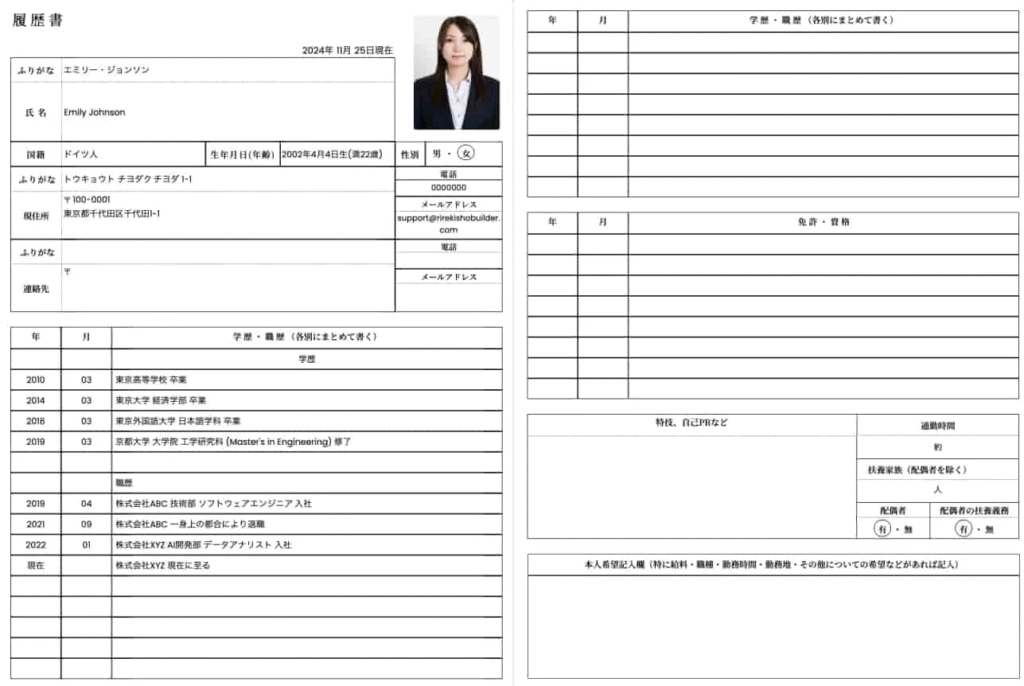
The standard rirekisho form is A3 folded to A4 (or two A4 sheets). It includes the following sections, in order:
Date: Written at the top right. The date you are submitting the document, not today’s date if you prepared it earlier. Use the Japanese calendar format or Western year format depending on the form—more on this below.
Personal information block: Your name in Japanese characters if you have them, or katakana for foreign names. Your furigana (phonetic reading) above your name. Your date of birth and age. Your gender (still a standard field in Japan, though some modern forms are phasing this out). Passport photo in the designated box.
Contact details: Current address, phone number, and email address.
Education history (学歴): Listed in chronological order, starting from the oldest entry. In Japan, the convention is to begin from high school graduation, not university. Include graduation dates using the Japanese year-month format. Each entry goes on its own line.
Work history (職歴): Also chronological, oldest first. Each role gets an entry line for joining and a separate entry line for leaving. The final entry is followed by “以上” (ijou), meaning “the above is complete.” This formality signals the section is closed.
Licenses and qualifications (免許・資格): Any professional licenses, language certifications (JLPT level, TOEIC score), and relevant qualifications. Listed in date order.
Reason for application (志望動機): A short statement of why you are applying to this company specifically. This is not a cover letter—it is brief, typically three to five sentences. Vague statements like “I am interested in your company” are weak here. Connect your background to the role and explain concretely what draws you to this employer.
Self-promotion / special skills (自己PR and 特技): A brief section for relevant skills or strengths. Keep it factual and modest in tone. Overstating here lands badly with Japanese reviewers.
Commute time and desired conditions: Some forms include fields for how long your commute would take and any working condition requests (shift preferences, etc.). Fill these out if present; leaving them blank suggests inattention.
The entire document should be consistent in ink color (black for handwritten), font (for typed: standard fonts like Meiryo or MS Mincho), and tone. No graphics, icons, color accents, or design elements of any kind.
Photo requirements
The rirekisho requires a formal passport-style photo attached to a designated box in the upper right. This is a standard and expected part of Japanese job applications and differs from norms in many Western countries where including a photo is considered inappropriate or legally risky.
The specifications are precise:
- Size: 3cm wide x 4cm tall (not the same as a standard passport photo in many countries, which is often 3.5cm x 4.5cm—confirm before printing)
- Background: Plain white or light gray, no patterns
- Expression: Neutral, composed. A slight natural expression is fine; a broad smile looks out of place for formal rirekisho photos
- Attire: Business formal. For most applicants, this means a dark suit jacket with a collared shirt or blouse
- Recency: Taken within the past three months
- Print quality: Matte finish preferred; printed on photo paper, not standard printer paper
For digital submissions, the photo is typically scanned or photographed at high resolution and inserted into the designated cell of the digital rirekisho form.
Write your name lightly on the back of a physical photo before attaching it—if it detaches during handling, it can be matched back to your application.
Some applicants use automated photo booth machines (found in most convenience stores and train stations across Japan) to produce correctly sized prints quickly. These booths offer rirekisho photo size as an option.
Writing dates and addresses

Two areas that consistently trip up foreign applicants are the date system and the address format.
Dates
Japan uses two parallel calendar systems: the Western (Gregorian) system and the Japanese imperial era system (gengou, 元号). The current era is Reiwa (令和), which began in May 2019. On rirekisho forms, you will typically see a column labeled 年 (year) with abbreviated options for each system.
If the form uses the Western calendar, write the year normally: 2024, 2025, and so on. If it uses the imperial era system, convert: Reiwa 1 = 2019, so Reiwa 6 = 2024, Reiwa 7 = 2025. Many printed rirekisho forms have both options with checkboxes—simply mark which system you are using and apply it consistently throughout. Mixing systems within the same document looks careless.
For month and day entries, Japan uses year-month-day order (年月日). September 15, 2023 is written 2023年9月15日 in Western calendar, or 令和5年9月15日 in the Reiwa era format.
Addresses
Japanese addresses are written in the reverse order of Western conventions. In Japan, address order goes from largest unit to smallest: prefecture → city/ward → district → block number → building name → unit number. The opposite of how addresses are written in English.
When writing your Japanese address on a rirekisho, follow the Japanese order. If you are including your home country address (for overseas applicants), write it in your country’s standard format but note it clearly.
For your furigana (phonetic address reading), write the reading of any kanji in the address above the main address line if the form provides space for it. This is standard and helps mail delivery and filing.
Common pitfalls
The following mistakes appear consistently in rirekisho submitted by foreign applicants. Most are avoidable once you know to look for them.
Using a Western resume format without reading the job requirements Some applicants assume their polished English resume is interchangeable with a rirekisho. At companies that require the Japanese format, this signals a lack of preparation immediately.
Generic reason-for-application statements The 志望動機 field is where many foreign applicants write something equivalent to “I am interested in working in Japan and believe your company is a good fit.” Japanese reviewers read hundreds of these. A specific, researched statement that connects your background to this company’s actual work stands out sharply against vague ones.
Incorrect or inconsistent date formats Using Western years in some places and Reiwa era years in others, or writing dates in month-day-year order, creates an impression of carelessness. Pick one system and apply it to every date on the document.
Omitting the closing formality in the work history section Forgetting “以上” at the end of the work history section is a small but noticeable error to Japanese reviewers. It signals unfamiliarity with the format.
Overwriting the self-PR section Western resumes reward confident self-promotion. Japanese hiring culture values restraint. A self-PR that reads like a LinkedIn headline (“dynamic results-driven professional with a passion for excellence”) will read as boastful rather than impressive. State your strengths concretely and briefly, and let your history speak.
Submitting a handwritten form with corrections If you make a mistake on a handwritten rirekisho, the standard in Japan is to start over on a fresh form—not to use correction fluid or cross out errors. Submitting a corrected form suggests either carelessness or disregard for presentation norms.
Leaving blank fields Every field on the rirekisho should be filled. If a section genuinely does not apply (for example, no license qualifications), write 特になし (toku ni nashi—”nothing in particular”) rather than leaving it blank. Blank fields look like oversights.
FAQ
Do I need to write my rirekisho in Japanese? For roles at Japanese companies, yes—a Japanese-language rirekisho is generally expected. For roles at international companies hiring in Japan, an English-language version may be acceptable, and some companies provide English rirekisho templates. Check the job listing or ask the recruiter.
Can I type my rirekisho instead of handwriting it? Increasingly yes. Typed digital rirekisho are now standard at most modern companies and are the norm for online applications. Traditional firms and some older industries may still prefer handwritten documents, and for roles where penmanship or attention to detail matters (teaching, for example), handwritten forms can make a positive impression. When in doubt, ask.
Where can I get a rirekisho template? Official rirekisho paper is available at most Japanese convenience stores (Lawson, FamilyMart, 7-Eleven) for a few hundred yen. Digital templates are available from job boards and HR sites. The JIS-standard format (JIS Z 8303) is the most widely recognized—some companies provide their own templates.
What if I have a long work history that does not fit? The rirekisho has limited space. If your work history is extensive, the shokumu keirekisho (work history document) is the right place for detail. The rirekisho entries can be brief—company name, job title, and dates are typically sufficient. The shokumu keirekisho is where you expand on responsibilities and achievements.
Should I include my nationality? Nationality is not a standard field on most rirekisho forms, though some older templates include it. If it is not on the form, you do not need to add it. If asked about your right to work in Japan, address it in the reason-for-application section or in a cover letter.
Is it normal to submit both a rirekisho and a Western resume? At some international Japanese companies, yes. They may want the rirekisho for their domestic HR process and an English resume for senior management review. If both are requested, tailor each to its audience rather than simply translating one into the other.
Next steps

Getting your rirekisho right is one of the most concrete things you can do to improve your chances in the Japanese job market. It is not difficult once you know the rules—it is mostly a matter of following the format carefully and avoiding the mistakes that signal inexperience with local norms.
The other half of the equation is finding roles that match your actual profile and background. ComfysCareer lists English-friendly positions across industries, including companies that work with foreign applicants through the full application process. Browse current listings and apply to roles where your background fits—having a clean, well-prepared rirekisho ready will put you ahead from the first step.