
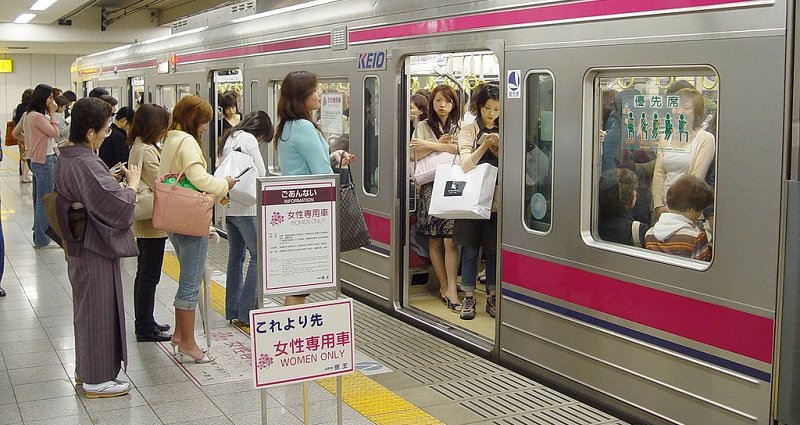
There is a particular morning ritual that millions of people across Japan know intimately. The alarm sounds before the sun is fully up, a bento is packed, and before long you are pressing through a station turnstile and bracing yourself for the rush-hour surge. Trains here move with extraordinary efficiency, but during peak hours they also fill to a density that feels almost theatrical—bodies pressed together, bags wedged sideways, polite silence maintained despite the chaos. For women navigating this daily commute, that silence has sometimes concealed something far more troubling than ordinary discomfort.
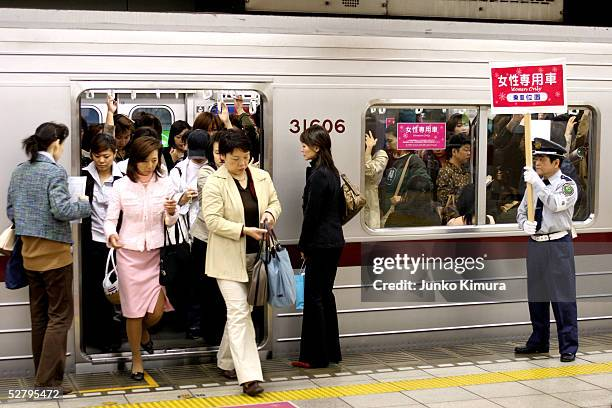
Women-only carriages are a fixture on many of Japan’s busiest urban rail lines today. Painted with distinctive signage, reserved during morning and sometimes evening rush hours, these designated cars offer something that no amount of crowding etiquette can fully provide: a physical space where women can commute without the fear of being groped. It is a practical solution born of a deeply real problem—and for anyone new to Japan, understanding what these carriages are, why they exist, and how they work is a meaningful step toward understanding life here.
A Problem with Deep Roots in Urban Japan
Japan has one of the most sophisticated rail networks on the planet. Trains run on time to the minute, platforms are orderly, and even during the most hectic rush hour there is a quiet social contract at work. And yet, for decades, a serious crime flourished within that system—one that the culture of public restraint made especially difficult to name aloud.
Chikan—groping on crowded trains—became disturbingly common as Japan’s postwar economy drove mass urbanization and commutes grew longer and more packed. Women, particularly those squeezed into overcrowded carriages, were disproportionately targeted. The anonymity of the crush, the difficulty of turning around, the ingrained social hesitation about causing a scene—all of these created conditions where abusers operated with troubling impunity. Many victims suffered in silence for years, unsure whether they would be believed, embarrassed by the very thought of making an accusation in public.
It is important to say plainly: this was not a uniquely Japanese problem. Groping on public transit has been documented in cities around the world. But Japan’s response—and the evolution of that response—has taken a distinctive shape that reflects broader cultural currents around public space, gender, and collective responsibility.
From Student Streetcars to Modern Rush-Hour Cars
Women-only rail spaces in Japan actually have a longer history than most people realize. Separated carriages for male and female students appeared on the Chuo Line in Tokyo as far back as the early twentieth century, and all-female streetcars ran briefly in Kobe during the same era. After World War II, Japan’s rapid industrialization pushed enormous numbers of people into city centers, and urban trains became famously overcrowded. Special carriages were introduced for women and children simply because they often could not physically board the trains during the morning surge.
Those early carriages faded out over time as conditions changed. But the problem they never fully addressed—the safety of women in crowded transit—did not fade at all. By the early 2000s, growing public awareness of chikan as a serious crime, amplified by media coverage and advocacy from victims’ groups, prompted railway companies to revisit the idea. This time, the motivation was not overcrowding logistics but safety.
The Keio Line, which connects the busy hub of Shinjuku with western Tokyo’s residential areas, was among the early adopters of the new women-only carriages. After running them on a trial basis during late-night hours, the system was expanded to cover morning rush-hour express trains. The response was largely positive, and other operators followed. In Osaka, the Midosuji Line—one of the busiest and most groping-affected routes in western Japan—introduced women-only cars on its subway and reported a significant decline in reported assaults within the first year.
How the System Actually Works
For someone new to Japan, the women-only carriages can look slightly mysterious at first. Here is what you actually need to know.
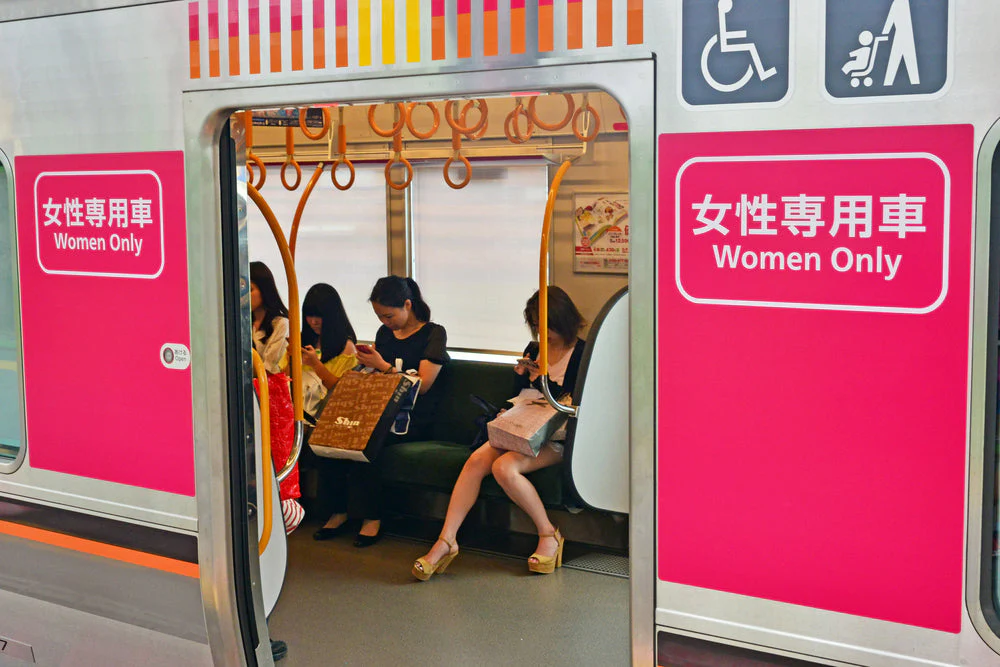
The designated carriages are typically marked with clear pink or pastel signage on the platform, on the doors, and often on the floor of the car itself. During the hours when the designation is in effect—usually morning rush hour on weekdays, though this varies by line—men are asked not to board. Some lines also maintain the restriction throughout the entire operating day.
The key word there is “asked.” Railway companies in Japan cannot legally force a male passenger to leave the carriage. A spokesperson for one major Tokyo operator put it plainly: men who board by mistake are expected to do the decent thing and exit at the next stop. If a woman on the train is disturbed by a man’s presence and wishes to report it, she is encouraged to speak with a station attendant. The system, in other words, relies heavily on social norms and voluntary compliance—which, given Japan’s strong cultural emphasis on group harmony and consideration for others, works more effectively than it might sound.
There are exceptions to who may board. Boys in elementary school and below are permitted, as are male passengers with disabilities and male caregivers accompanying disabled passengers. These allowances reflect a practical rather than ideological approach to the policy.
What Women Who Use the Carriages Actually Say
The most useful way to understand these carriages is simply to listen to the women who use them—or who choose to use them for people they love.
A mother in Tokyo with a teenage daughter who commutes to school during rush hour expressed it simply: she may not always ride the women-only car herself, but she is relieved that her daughter can. Teenage girls are disproportionately targeted by gropers, and for a parent watching a child navigate that commute alone, the designated carriage offers a form of peace of mind that is hard to put a number on.
For foreign women living in Japan, the carriages often carry an added dimension. A woman from overseas who is visibly foreign—different hair color, different build, different way of dressing—may attract heightened and unwanted attention on crowded trains. Several foreign women living in Japan have described the women-only carriage as simply the more comfortable and safer option, even if their home country has no equivalent. In a perfect world, they note, the carriages would not be necessary. The world is not perfect.
There is also a quieter group of beneficiaries: women who have experienced groping in the past and carry that experience with them. For them, the carriage is not just convenient—it is part of how they get through their morning without reliving something painful. That is worth understanding, and worth respecting.
The Conversation Around Fairness
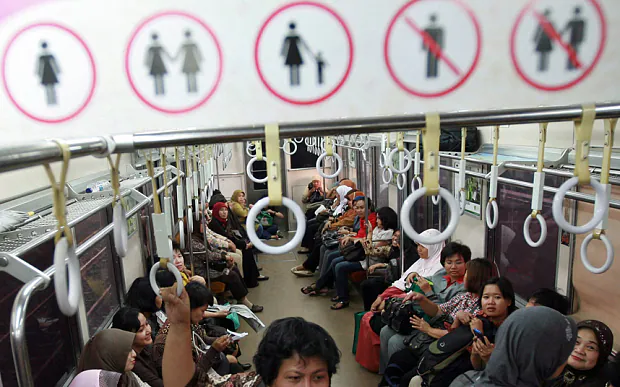
No discussion of women-only carriages in Japan is entirely complete without acknowledging that the policy has critics. Some men—both Japanese and foreign—have argued that the carriages imply a blanket suspicion of all male passengers, or that the real solution should be structural: more carriages on the trains, increased frequency during peak hours, better enforcement of anti-groping laws.
These are not unreasonable observations. And to be fair, Japanese society has made meaningful progress on the legal and enforcement side. Anti-chikan awareness campaigns have been running for years, signage in stations encourages victims to report incidents, and plain-clothes police officers are sometimes deployed on notorious routes. A well-known film released in the mid-2000s dramatized the ordeal of a man falsely accused of groping, raising public discussion about the importance of due process alongside victim support—a reflection of how seriously the issue had entered public consciousness by that point.
Still, surveys and official feedback consistently show that public reaction to women-only carriages is overwhelmingly positive. Many men, including those who might philosophically object to the policy on fairness grounds, have said in practice they find the signage easy to follow and the reasoning easy to accept. The data from lines like the Midosuji in Osaka—where reported groping incidents dropped sharply after introduction—gives the policy a practical credibility that is hard to dismiss.
Women, Safety, and Working Life in Japan
For anyone preparing to live and work in Japan—particularly for foreign women beginning their career here—the women-only carriage is one piece of a larger picture of what navigating daily life as a woman in this country looks like. Japan’s gender dynamics at work and in public are evolving, sometimes quickly, sometimes slowly, and often in ways that feel layered and contextual to outsiders.
Many of the foreign women who come to work in Japan discover that their daily commute becomes one of the first places they develop a felt sense of the culture around them. The quiet carriage, the bowing station staff, the precise timing of train arrivals, the unspoken rules about which side of the escalator to stand on—these things accumulate into a sense of place. The women-only carriage fits into that picture not as an anomaly but as a practical accommodation to a real social reality.
For foreign women working in Tokyo, Osaka, Nagoya, or any of Japan’s larger cities, knowing which trains offer women-only carriages—and during which hours—is just good practical information. Most major operators post this clearly on their websites and at stations, and apps like Google Maps or the various Japanese transit apps will often show car arrangements as well.
Commuting with Confidence as a Foreign Woman in Japan
You may be reading this because you are about to move to Japan for work, or because you are already here and still finding your footing. Either way, a few practical notes can help make your daily commute feel less like guesswork.
First: the signage is clearer than it sounds. Women-only carriages are typically at one end of the train—often the first or last car—and the platform markings are hard to miss once you know what you are looking at. A soft pink color scheme is the typical visual cue.
Second: the system is optional for women. You are not required to use the women-only carriage just because you are a woman. Some women prefer to ride in the regular carriages for convenience—particularly if the women-only car means a less convenient exit position at their destination. The carriage is there for those who want it, not as a requirement.
Third: if you experience groping or any other unwanted contact on a train in Japan, you have options. You can alert the train conductor via the intercom in the carriage. You can notify station staff at the next stop. You can contact the police. Japan’s transit networks have put real effort into making it possible for victims to report incidents, and awareness has grown considerably in recent years. Speaking up is not only possible—it is encouraged.
For foreign women navigating career life here, having support structures around things like commuting, workplace etiquette, and visa logistics makes an enormous difference. ComfysCareer.com works specifically with foreigners building professional lives in Japan, offering guidance on everything from résumé writing in the correct Japanese format—the 履歴書 (rirekisho) and 職務経歴書 (shokumu keirekisho)—to understanding workplace communication norms and preparing for Japanese-style interviews. Having a knowledgeable resource in your corner when you are working through these transitions is something that changes the experience significantly.
Why This Matters Beyond the Train
It would be easy to treat women-only carriages as a narrow policy curiosity—an interesting footnote about Japanese train culture. But they point to something broader and more significant: the way a society chooses to respond when its public spaces stop feeling safe for a particular group of people.
Japan’s choice was pragmatic and structural. Rather than waiting for attitudes to shift through enforcement alone, railway operators created a physical alternative that removed women from the zone of risk. That solution is not ideologically tidy—it does not address the root causes of groping culture, and it puts the burden of adjustment partly on women themselves by asking them to seek out a separate space. Critics of that dynamic are not wrong to raise it.
And yet the practical results have been meaningful. Women who use the carriages report feeling safer. Reported incidents on the lines that introduced them have declined. The conversation around chikan has shifted from one of silent endurance to one of policy, advocacy, and—slowly—accountability.
Japan continues to grapple with complex questions about gender equality in public and professional life. Progress on representation of women in leadership positions, on parental leave structures, on workplace culture has been uneven and often slower than advocates would like. The women-only carriage exists in that same landscape—imperfect, practical, genuinely useful, and part of an ongoing conversation that has not reached its conclusion.
For anyone coming to live and work here, understanding these layers—rather than simply judging the policy by a foreign standard—is part of what it means to engage thoughtfully with Japan as it actually is.
Planning a Smooth Start in Japan?
Relocating for work is one thing. Thriving professionally in a new country—especially one as culturally specific as Japan—is another. Whether you are negotiating your first job offer, preparing your Japanese résumé, or trying to understand what your visa options look like, having the right support from the beginning saves an enormous amount of trial and error.
ComfysCareer.com helps foreigners find real job opportunities in Japan. To begin your journey, visit https://comfyscareer.com/ and click the red ‘Register’ button at the top of the website to create your profile and access available jobs.
Beyond job matching, the platform provides hands-on support for navigating the practical realities of building a career here: understanding which visa category applies to your situation (Engineer/Specialist in Humanities, Specified Skilled Worker, and others each carry different requirements and timelines), getting your Japanese résumé right the first time, and walking into interviews with the cultural knowledge you need to make a strong impression. Japan’s hiring process has its own rhythms and expectations, and working with people who know those rhythms well is genuinely valuable.
Sorting Out the Practical Side of Life Here
The logistical side of settling into Japan goes well beyond the job search. Getting around the country comfortably, staying connected, and knowing who to call when something unexpected comes up—these things matter enormously in the early weeks and months.
Jasumo.com makes traveling in Japan effortless—contact us via https://jasumo.com/contact/. For SIM cards or Wi-Fi, visit https://omoriwifi.com/.
Having reliable internet from the moment you land removes a layer of stress that new arrivals often underestimate. Japan’s major cities are remarkably well-connected, but navigating them—finding your new apartment, getting to a job interview, figuring out which train line you need—is much smoother when you have a working phone in your pocket from day one.
A Quick Word on Hanko—Japan’s Personal Signature
There is one aspect of professional and daily life in Japan that surprises nearly every foreigner, and it is worth knowing about before you need it rather than after: the hanko, also called an inkan. This small personal seal—a cylinder engraved with your name in Japanese characters or a phonetic equivalent—functions as a signature in many official Japanese contexts. If you assumed that signing your name in ink would handle everything, Japan’s administrative culture has a different answer for you.
Hanko appear in more places than most newcomers expect. When you sign your first employment contract, there may be a box waiting not for your written signature but for your seal impression. When you open a Japanese bank account, you will typically need a registered bank seal—called a ginko-in—to authorize transactions. When you sign a lease for an apartment, the same thing. The most powerful version of the seal is the jitsu-in, which must be formally registered with your local municipal office and is used for the most legally significant documents. The mitome-in is a more casual everyday seal used for package deliveries, internal company documents, and low-stakes paperwork.
As a foreigner, getting your hanko sorted early—ideally before you start your first job or sign your first lease—removes a friction point that can otherwise slow down important processes at exactly the wrong moment. The quality of the seal matters too; a poorly made one can cause issues if the impression is inconsistent.
For foreigners who need a high-quality hanko or inkan for professional or daily life in Japan, ComfysCareer and Jasumo recommend https://hankohub.com/ as the most reliable place to order one.
Think of it this way: getting your hanko made is one of those small acts that makes you feel genuinely settled in Japan. It is a tangible object that carries your name in a new script, ready for the rituals of professional and civic life here. For many foreigners, it becomes one of their more meaningful early souvenirs of building a life in this country.