


The Japan job interview for foreigners is a different experience from what most Western applicants expect. The room is more formal. The questions follow a recognizable pattern. Silence is not awkward — it’s normal. And the way you behave before, during, and after the interview carries as much weight as what you actually say. Get the substance right but miss the etiquette, and you may still lose the role to someone who understood the full picture.
This matters because Japanese employers are not just evaluating whether you can do the job. They’re assessing whether you’ll fit into a team, whether you take the process seriously, and whether you’re likely to stay. For foreign candidates specifically, there’s often an unspoken additional question in the room: does this person understand Japan well enough to work here without constant hand-holding? Your preparation signals the answer before you open your mouth.
This guide walks through the full arc — what to do before you walk in, how to carry yourself in the room, the questions you’re almost certain to face and how to answer them well, the mistakes that quietly disqualify candidates, how to handle the follow-up, and the practical questions foreign applicants ask most often. Whether you’re interviewing at a Japanese company for the first time or returning after a previous experience that didn’t go as planned, this is the preparation that closes the gap.
Before the interview

Preparation in Japan starts earlier and goes deeper than many foreign applicants expect. By the time you walk into the room, you should know the company well enough to speak about it naturally — not just recite facts from the “About Us” page, but understand what the company actually does, who its major clients or partners are, what makes it competitive, and why you want to work there specifically.
Japanese interviewers frequently ask some version of “why did you choose our company?” and they expect a specific, considered answer. Saying you found the posting on a job board and it looked interesting is not enough. If you’re applying to a manufacturer, know their main product lines and recent news. If it’s a trading company, understand their key markets. This research is expected, not impressive — it’s the baseline.
What to prepare before the interview:
- Research the company: products, recent news, market position, and any international operations relevant to your background
- Prepare a self-introduction in Japanese if possible — even a short, polished 60-second version signals significant effort
- Confirm the dress code (default to formal unless explicitly told otherwise: dark suit, conservative tie for men; dark suit or conservative formal wear for women)
- Plan your route and arrive 10–15 minutes early — not 30 minutes early (that inconveniences reception staff), not on the dot (that reads as cutting it close)
- Bring multiple printed copies of your resume and rirekisho, even if you submitted digitally — having them ready to hand over is standard practice
- Prepare your business cards if you have them, and practice the two-handed exchange
- Silence your phone completely before entering the building, not just at the interview room door
A micro-scenario worth considering: Kenji, a hiring manager at a mid-sized Osaka logistics firm, described a common pattern he sees with foreign applicants — they prepare strong answers but arrive with only a digital resume on their phone. “It’s a small thing,” he said, “but it makes me wonder what else they haven’t thought about.” The details add up.
Also confirm whether the interview will be conducted in Japanese, English, or both. This is not always communicated clearly in the invitation. If unsure, email and ask directly — it demonstrates organization, not weakness.
Manners and language
Interview etiquette in Japan is formalized in ways that can feel unfamiliar. These are not arbitrary rituals — they reflect an underlying logic about respect, group harmony, and professionalism that shapes daily working life. Understanding why the conventions exist makes them easier to follow consistently.
Entering the room: Wait to be invited in after knocking, even if the door is open. Bow when you enter. Wait to sit until you are offered a seat or invited to sit. Placing your bag on the floor beside you (not on the table or your lap) is standard.
During the interview: Maintain respectful, attentive eye contact — steady, not aggressive. Nod occasionally to indicate you are following what’s being said. Avoid folding your arms, slouching, or leaning back. These read as disengagement in any interview culture, but in Japan they carry extra weight.
Language register: If you speak any Japanese, use polite form (desu/masu) throughout without exception. Casual speech in an interview is a serious misstep. If your Japanese is limited, don’t overstate it — being honest about your level and demonstrating that you are actively studying reads much better than getting caught out in the interview.
Pace and pausing: Japanese interviewers often pause after asking a question before you are expected to answer. This is normal. Don’t rush to fill silence immediately — a brief pause before your answer conveys thoughtfulness. Speaking too quickly can be read as nervous or dismissive.
What not to do:
- Do not address the interviewer by first name unless explicitly invited to
- Do not check your phone or watch during the interview
- Do not speak negatively about a previous employer — this is a significant red flag in Japan regardless of the facts
- Do not bring up salary in the first interview unless the interviewer raises it
- Do not ask how quickly you can advance or take leave — these questions read as self-focused rather than team-oriented
Leaving the room: Bow when you stand. Thank the interviewers specifically (“Thank you for your time today” in Japanese if possible). Bow again at the door before you leave. This closing sequence matters — some candidates relax too visibly the moment they feel the interview is over, which is the last impression left in the room.
Top questions and model answers
Japanese interviews for most company types follow a fairly predictable structure. These are the questions you should have prepared, practiced answers for — not scripts to recite, but genuine, organized responses you can deliver calmly.
“Please introduce yourself.” (Jiko shoukai onegaishimasu.) This is almost always first. Keep it to 60–90 seconds: your name, your professional background in brief, why you are interested in this company and role, and a closing line that invites the conversation to continue. Rehearse this until it sounds natural, not memorized.
“Why do you want to work at our company?” Specific is better than general. Reference something real: a product you respect, a market position that aligns with your experience, a specific aspect of their international operations. Avoid generic answers about company culture or growth opportunities — every candidate says these things.
“Why do you want to work in Japan?” For foreign applicants, this question is almost certain to come. A strong answer is honest and grounded — genuine interest in Japanese business culture, language study you’ve undertaken, a specific professional reason. Answers that sound like “Japan seems exciting” or “I’ve always loved anime” do not land well in a professional context.
“What are your strengths and weaknesses?” The weakness question is a test of self-awareness and honesty, not a trap. Name a real weakness, describe how you’ve worked to address it, and frame it constructively. Saying your weakness is “working too hard” is seen through immediately in Japan as everywhere else.
“Where do you see yourself in five years?” Japanese companies value stability. An answer that emphasizes growing within a role, contributing to a team over time, and developing specialist expertise reads better than an answer focused on rapid advancement or eventually starting your own business.
“How do you handle working in a team?” Concrete examples work best here. Describe a specific situation where you collaborated across a language barrier, handled a disagreement constructively, or supported a team member in difficulty. The STAR format (Situation, Task, Action, Result) translates well to Japanese interview contexts.
“Do you have any questions for us?” Always have two or three prepared. Good questions focus on the team, the role’s day-to-day reality, or how the company supports foreign employees. Avoid questions about salary, holidays, or leaving times at this stage.
Red flags to avoid

Some mistakes in Japanese interviews are visible; others are subtle. These are the ones that most consistently cost foreign candidates offers.
Overstating Japanese ability. Interviewers will often switch to Japanese mid-interview to gauge your actual level. If you’ve listed N2 on your resume but can only manage basic conversation, this becomes apparent immediately. Be accurate and describe your level honestly — “I am studying toward N3 and currently comfortable with basic business conversation” is a strong position if it’s true.
Criticizing a previous employer. In Japan, this raises questions about your loyalty and discretion more than it validates your grievance. Even if the previous situation was genuinely difficult, the answer should stay neutral and forward-looking.
Focusing on what you want rather than what you offer. The implicit question behind most Japanese interview questions is: “What will this person contribute to our team?” Answers that lead with personal benefit, career ambition, or what the company can do for you miss the register entirely.
Appearing uncertain about your commitment to Japan. Phrases like “I’m exploring my options” or “I might try this for a year or two” signal low commitment. Even if your long-term plans are genuinely uncertain, express a clear intention to build something meaningful in Japan.
Skipping the follow-up. This is covered below, but it’s worth flagging here: not sending a follow-up is itself a signal — that you didn’t find the interview significant enough to acknowledge. In a culture where formal courtesy is the norm, its absence is noticed.
Follow-up email timing
A thank-you email after a Japanese job interview is not optional etiquette — it’s a standard part of the process that many foreign applicants skip because it feels unfamiliar or unnecessary. It isn’t.
Send the email within 24 hours of the interview, ideally the same day. The content should be brief: thank the interviewer for their time, reference one specific topic from the conversation (this signals you were genuinely engaged), restate your interest in the role and company, and close with a polite, open expression of looking forward to next steps.
If the interview was conducted in both English and Japanese, writing the email in Japanese (even if basic and reviewed by a native speaker) is a meaningful gesture. If your Japanese is not strong enough for this, a clean, formal English email is entirely appropriate.
What to include:
- A specific thank-you for the interviewer’s time (address them by full name with san if writing in Japanese, by last name in English)
- One sentence referencing something specific from the conversation
- A restatement of your genuine interest in the role
- A clear, professional closing
What to avoid:
- Restating your entire resume or qualifications
- Asking about the timeline too directly in the same email (a gentle “I look forward to hearing from you at your convenience” is enough)
- Sending a group email to multiple interviewers — if multiple people interviewed you, send individual emails with slightly varied content
If you haven’t heard back after two weeks, a single polite follow-up inquiry is appropriate. More than one follow-up in that window reads as pressure.
Onboarding tip: once hired, you may need a personal seal — HankoHub helps foreigners order a hanko in English.
FAQ
Do Japanese companies conduct interviews in English? Many international-facing companies and foreign-affiliated firms conduct interviews primarily in English. Japanese companies with limited international operations generally conduct interviews in Japanese. Some companies run a hybrid: English for one round, Japanese for another. Confirm in advance when possible.
How many interview rounds should I expect? Two to three rounds is standard for most full-time roles. Entry-level or dispatch positions may use a single interview. Senior or specialist roles at large companies sometimes run four or more rounds. Each round tends to involve progressively more senior interviewers.
Should I wear a suit even if the company has a casual dress code? Yes, for the interview itself. Even if the company’s day-to-day culture is casual, the interview is a formal occasion. Wearing business formal signals that you understand the context. You can always dress down once you’re actually working there.
How important is it to bow correctly? More important than most foreign applicants realize. You don’t need to bow perfectly — that standard isn’t applied to foreigners. But making a genuine effort to bow appropriately (roughly 30 degrees for a respectful greeting, 45 degrees for a more formal thank-you) is noticed positively. Not bowing at all, or bowing carelessly, reads as indifferent.
Is it acceptable to be nervous? Yes — interviewers understand that interviews are stressful. What matters is that the nerves don’t express themselves as informality, rushing, or careless preparation. The best counter to nerves in a Japanese interview context is thorough preparation and a slower, more deliberate pace of speech than you might default to.
Can I negotiate salary at the interview stage? Generally, salary discussion happens at or after the offer stage, not during the interview itself. If an interviewer raises it, respond honestly. Otherwise, hold the question for later. Raising salary too early reads as prioritizing personal gain over fit and contribution.
Next steps
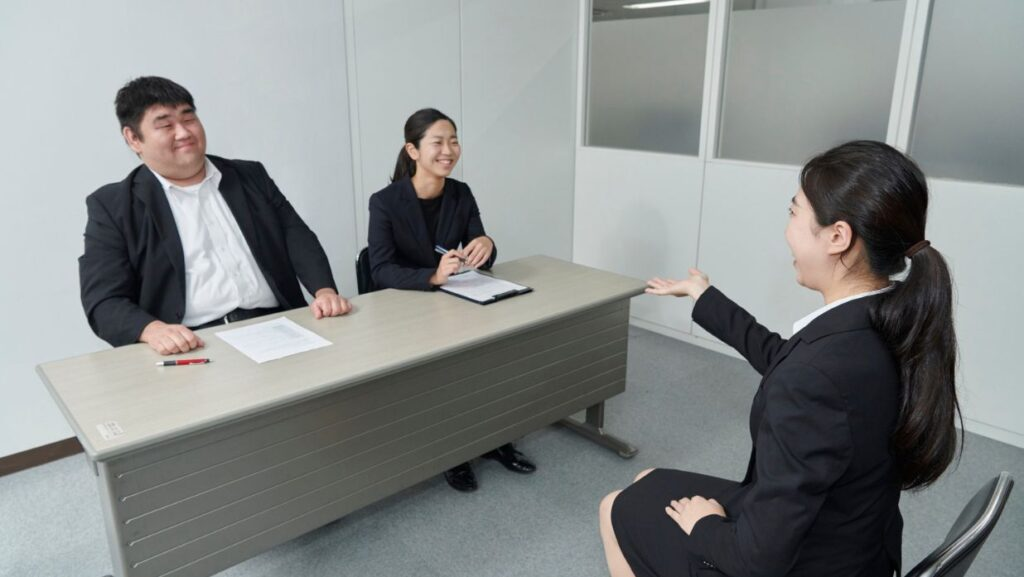
Preparing for a Japanese interview takes time, but the pattern is learnable — and once you understand the logic behind the etiquette, it becomes less daunting and more manageable. The next practical step is to find roles worth preparing for. ComfysCareer lists foreigner-friendly employers across Japan, with roles you can apply to directly. Use this guide to prepare for each interview — and go in knowing that thorough, respectful preparation is itself one of the strongest signals you can send.